
Graffiti Removal for Brick, Stucco, and Painted Exterior Surfaces
 |
Published August 3, 2026 Michael Thorgersen, Owner, Aqua Clean Solutions, Inc. |
How Is Graffiti Removed from Brick, Stucco, and Painted Surfaces?
Graffiti removal depends on the substrate. Porous brick needs a chemical remover with proper dwell time followed by a controlled low-pressure rinse; stucco needs the gentlest possible approach to protect its finish coat; and painted surfaces often require repainting because removers strip the host paint along with the tag. Aqua Clean Solutions matches methods to material across Northern Virginia and Southern Maryland.
Why the Same Graffiti Comes Off Three Different Ways
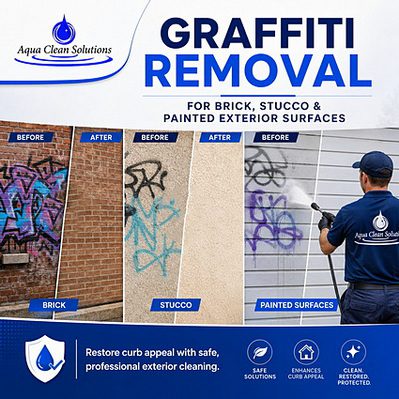
AI-generated for illustrative purposes only.
Graffiti is not a stain in the way algae or pollution film is a stain. It is a coating that has been deliberately applied, and how deeply it sets depends almost entirely on what it was sprayed onto.
Two properties decide the outcome. The first is porosity. Brick, mortar, and stucco are all porous, meaning the surface is riddled with tiny voids that pull liquid paint inward by capillary action within seconds of contact. The second is chemical compatibility. Solvent-based removers do not distinguish between the paint a vandal applied and the paint a building owner applied, which is why the safest method on bare masonry becomes the most destructive method on a painted wall.
This is why a single technique applied across a whole building produces uneven results. A crew that cleans a brick pilaster, a stucco field wall, and a painted steel door with the same chemistry and the same pressure setting will succeed on one, damage the second, and leave a visible outline on the third.
Graffiti Removal from Brick and Masonry
Brick is the most forgiving substrate chemically and the least forgiving mechanically.
Because fired brick and mortar tolerate solvents well, the removal sequence leads with chemistry rather than force. A masonry-rated graffiti remover is applied to the tagged area, allowed to dwell for the interval specified on the product label, and then flushed. The remover does the work of breaking the bond between the paint and the substrate. Water only carries the dissolved material away.
The mechanical risk is the part most people underestimate. Brick and mortar erode under sustained high pressure, and mortar joints erode faster than the brick face because mortar is softer. Aggressive pressure washing on masonry does not simply clean it; it removes a thin layer of the surface itself. The result is a tagged area that reads as lighter and rougher than the wall around it, a permanent record of the cleaning rather than of the graffiti. Historic and softer handmade brick is more vulnerable still.
Professional practice keeps rinse pressure on masonry well below the settings used on concrete flatwork, uses a fan tip rather than a concentrated jet, holds the wand at a consistent standoff distance, and works in overlapping passes. Heated water is frequently more effective than added pressure, because temperature accelerates the chemical reaction without adding mechanical force. Where organic staining is also present on the wall, that is a separate treatment covered under stone work and brick cleaning.
Split-face block and rough-textured brick are the hardest cases. Their surface geometry gives paint far more anchoring area, and full removal usually takes multiple applications across more than one visit.
Graffiti Removal from Stucco and EIFS
Stucco and synthetic stucco cladding require the most conservative approach of the three surfaces, and the two are not the same material.
Traditional cement stucco is a cementitious coating over lath. Synthetic stucco, usually specified as EIFS, is a thin acrylic-based finish coat over an insulation board. The finish coat on an EIFS wall can be a small fraction of an inch thick, which means an aggressive remover or an over-pressurized rinse can go straight through the color layer and expose the base coat or the board behind it. That is no longer a cleaning problem; it is a repair, and on EIFS it can compromise the wall’s moisture barrier.
Removal on stucco therefore starts with the mildest effective chemistry and escalates only if needed, always after a test patch in an inconspicuous area. Rinsing stays firmly in the soft wash range, which relies on cleaning solution and low pressure rather than force. Solvent strength is limited because strong solvents attack acrylic finish coats directly.
Stucco is also the surface where the honest answer is most often partial removal followed by a recoat. When the paint has penetrated the texture profile, the choice is between accepting a faint shadow and pushing hard enough to damage the finish. Selecting the right method for a given substrate is the same judgment described in what surfaces should be soft washed and which need pressure washing.
Graffiti Removal from Painted Surfaces
Painted walls, painted metal, painted trim, doors, and bollards present a problem that no chemistry fully solves.
A graffiti remover works by softening and lifting paint. It has no way to identify which paint film is the intended one. On a painted substrate, the same product that lifts the tag will soften, dull, or strip the coating underneath it. Even where removal is technically successful, the cleaned patch usually differs from the surrounding wall in sheen, because the host paint has been chemically stressed and any surrounding UV fading remains untouched.
Practical treatment on painted surfaces falls into three paths:
- Light removal, used where the tag is fresh, the marking is thin, and the host coating is durable. A gentle solvent applied by hand can sometimes lift the tag with minimal effect on the coating below.
- Removal followed by spot repaint, used where the tag has to come off but the host paint will not survive it. The area is cleaned, primed if needed, and recoated with matched paint.
- Direct repaint, used where the substrate is already scheduled for coating or where the coating is old enough that a spot repair would stand out more than a full-panel recoat.
- Color matching is the deciding variable. A repainted section that does not match reads from the parking lot as clearly as the graffiti did. Matching to the original spec, and recoating to a natural break in the wall such as a control joint or a panel edge, is what repairs disappear.
Why the First 72 Hours Matter Most
Fresh graffiti is dramatically easier to remove than aged graffiti, and the difference is measured in days.
Paint continues to cure after it is applied, cross-linking as it dries and bonding progressively tighter to whatever it landed on. On porous substrates, it also continues to wick inward. Ultraviolet exposure compounds the problem, driving pigment deeper into the surface profile and making residual shadowing harder to lift.
There is a second reason for speed that has nothing to do with chemistry. Tagged surfaces attract additional tagging. A wall cleaned within a day or two is far less likely to be marked repeatedly than one that sits for weeks. Commercial property managers who treat graffiti as an on-call response item rather than a scheduled maintenance item consistently spend less over a year, which is why graffiti response is handled separately from routine service in a shopping center cleaning program.
Wash Water, Paint Solids, and Stormwater Rules in Northern Virginia
Graffiti removal generates a waste stream that ordinary exterior washing does not, and that distinction carries regulatory weight in this region.
The rinse from a graffiti job contains dissolved paint solids and spent remover. Northern Virginia jurisdictions operate under municipal separate storm sewer system permits issued through the Virginia Department of Environmental Quality under Clean Water Act authority. Fairfax County’s MS4 permit requires the county to run an illicit discharge and improper disposal program prohibiting non-stormwater discharges into the county MS4 and state waters, and material entering that system does not go to a wastewater treatment plant. Localities including the Town of Leesburg state plainly that dumping paint and similar materials into the storm drain system is prohibited.
The practical consequence is that wash water from graffiti removal should not be allowed to run to a storm drain. State guidance for wash activities directs operators to block the drain with a plug, seal, or boom so wash water cannot enter the storm sewer, to collect the accumulated water rather than let it discharge, and to confirm with the local sewer authority before any disposal to the sanitary sewer.
For a property owner, this is a contractor selection question. A crew that shows up with a wand and no containment plan is transferring a compliance exposure onto the property owner, because the discharge occurs on that owner’s site. Aqua Clean Solutions performs graffiti work with drain protection and wash water recovery appropriate to the site, and provides certificates of insurance on request.
Ghosting, Shadowing, and What a Realistic Result Looks Like
Complete removal is achievable on many surfaces. It is not achievable on all of them, and any contractor who promises a perfect result on every substrate before seeing the wall is guessing.
Ghosting is the faint outline that remains after the paint film itself is gone, caused by pigment that penetrated below the surface plane. It is most common on rough brick, split-face block, and textured stucco. Shadowing is the related effect where the cleaned area now looks brighter than the surrounding wall, because removal also stripped years of accumulated environmental soiling from that patch alone.
Shadowing has a straightforward remedy: clean a wider area to a natural boundary so the transition falls at an architectural edge instead of mid-wall. Ghosting has two remedies: an additional treatment cycle or a coating over the affected section. Which one applies is a judgment made at the wall, not over the phone.
Attempting to solve either problem with more pressure is the most common way a removable problem becomes a permanent one, a pattern documented in DIY pressure washing mistakes homeowners make.
Reducing the Odds of Repeat Tagging
Where a wall has been hit more than once, surface treatment becomes worth considering.
Anti-graffiti coatings fall into two families. Sacrificial coatings form a clear removable barrier over the substrate. When the wall is tagged, the coating is washed off along with the paint and then reapplied, which keeps the paint from ever touching the masonry. Permanent coatings form a durable non-porous film intended to survive repeated cleanings without reapplication.
Sacrificial products generally cost less per application and are more forgiving on breathable masonry, because they do not trap moisture in the wall the way some permanent films can. Permanent products cost more initially and suit surfaces that are tagged frequently. On historic masonry, coating selection should be reviewed carefully, since any film that reduces vapor transmission can cause problems inside the wall assembly.
Non-chemical measures matter as much as coatings. Lighting a blind elevation, trimming shrubs that provide cover, and cleaning quickly all reduce repeat incidents.
Graffiti Removal Service in Northern Virginia and Southern Maryland
Aqua Clean Solutions has provided exterior cleaning across Northern Virginia and Southern Maryland since 1995, working on residential, commercial, and government properties. The company is fully licensed and commercially insured, accredited by the Roof Cleaning Institute of America, adheres to Power Washing National Association standards, and is a member of the Cleaning Equipment Trade Association.
Graffiti work is handled as a response service rather than a scheduled one. A typical engagement begins with substrate identification, a test patch in a low-visibility area, and a written scope that states plainly whether the expected result is full removal, removal with possible ghosting, or removal followed by recoating.
Service covers Woodbridge, Montclair, Dumfries, Lake Ridge, Stafford, Manassas, Triangle, Fairfax, Arlington, Alexandria, Leesburg, Ashburn, Sterling, Reston, Herndon, Springfield, Lorton, Centreville, Chantilly, and surrounding communities, along with adjacent Southern Maryland markets. Multi-property portfolios can be bid on a master services basis, and graffiti response can be attached to an existing commercial cleaning program.
To have a tagged surface evaluated, request a free estimate or call 703-454-4452.
Frequently Asked Questions
Does pressure washing remove graffiti by itself?
Rarely, and attempting it usually causes damage. Pressure alone will not break the chemical bond between spray paint and a porous surface, so the pressure has to be raised until it erodes the substrate. Chemistry does the removal, and the rinse only carries away what the chemistry has already released.
Can graffiti be removed from brick without leaving a mark?
Often yes on smooth face brick, and less reliably on rough or split-face brick where pigment penetrates the texture. Where a faint outline remains, cleaning a wider area to a mortar line or an architectural edge usually makes the difference invisible from normal viewing distance.
Will graffiti removal damage stucco?
It can if the wrong method is used. Synthetic stucco in particular has a thin acrylic finish coat that strong solvents and high pressure can cut through. Removal on stucco stays in the soft wash range and begins with a test patch.
Do painted walls always have to be repainted after graffiti?
Not always, but frequently. Removers cannot distinguish tag paint from host paint, so on many painted surfaces the practical outcome is removal followed by a matched spot repaint. Fresh tags on durable coatings can sometimes be lifted with minimal effect on the paint below.
How quickly should graffiti be removed?
As soon as practical, ideally within a few days. Paint continues to cure and penetrate after application, and tagged walls attract further tagging.
What happens to the wash water?
It is contained rather than allowed to reach a storm drain. Storm drains in this region discharge to streams and rivers without treatment, and local ordinances prohibit non-stormwater material from entering them.
Is hot water better than higher pressure?
Usually yes on masonry. Heat accelerates the chemical reaction without adding mechanical force, which is the safer trade on brick, mortar, and stucco.
Do anti-graffiti coatings work?
They work well on repeatedly targeted walls. Sacrificial coatings are washed away with the tag and reapplied. Permanent coatings last longer but should be reviewed carefully on breathable or historic masonry.
Do you handle concrete and hardscape graffiti as well?
Yes. Concrete responds differently from vertical masonry and is addressed through concrete cleaning.